Samburu and Laikipa Trip Report

Kenya is hands down the best wildlife photography destination on earth. Last year I made a big trip to Zambia and Zimbabwe and was rather disappointed from the results photographically, so this year I wanted to go back to basics and visit a place that I knew would yield me great photos no matter what. It was a chaotic booking process, but after several months of back and forths between various camps and tour operators, I finally settled on a 3 week trip across Kenya's northern regions of Samburu and Laikipa, as well as in the Maasai Mara. For the purpose of this trip report, I'll be covering the first half of my trip, and the Mara portion will be its own report.
I hadn't visited Samburu in over 4 years since I usually avoid coming to Kenya in high season, but it is a park that is absolutely at it's best when the rivers dry up and the dust begins to swell in the desert. There's something magical about Samburu at this time, and even though it was expensive, I chose to spend 3 nights at Elephant Bedroom Camp which is the most iconic Samburu camp to stay at in my opinion.
We arrived late afternoon and immediately started our game drive. Samburu is well known for it's Special Five, five species of animals that are found here in Northern Kenya: the Somali ostrich, Grevy's Zebra, reticulated giraffe, gerenuk, and beisa oryx. And within the first couple hours in the park, I managed to see and photograph all of them! As well as an appearance by the vulturine guinea fowl which aren't part of the Special Five but are still only found here in the north.


After a bit of driving, a call came in on the radio about a leopard nearby, so we raced over only to find it up a tree as the light was almost completely gone. It wasn't exactly a revolutionary leopard photo, but Samburu is known as the Land of Leopards, so I was just happy to see one on my first drive.

During the night we heard lions roaring fairly close to camp, so set off to track them down. It took awhile but we finally found a pair of males sleeping in the bush. The photos again weren't terribly interesting, but it's still cool to see lions in the desert.

The rest of the drive was quiet, so I shot some environmental shots of giraffes and did a little birding with an augur buzzard too.


We had heard that there were some lions with cubs seen earlier in the morning, and while we couldn't find them before it got too hot, we decided they would be our focus for the afternoon drive.
After a bit of searching, we found two lioness who seemed keen on hunting.


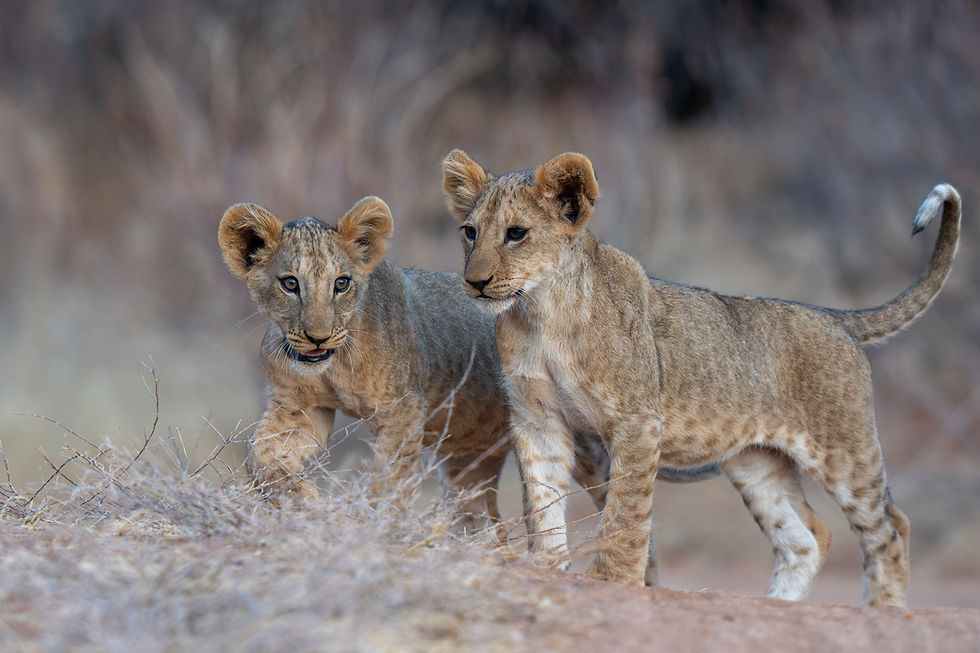
However they decided to abandon their efforts, most likely because they felt like they were too far away from where they had stashed their cubs. As they headed back into the bush we followed along until they reunited with 4 little cubs.


But while everyone was focused on the lions, I noticed that there was one car further away that was parked suspicously by some kopjes, and I just had a feeling that they were looking at something. I insisted we check it out, and when we got there I was surprised to see a leopard resting peacefully on the rocks! Our decision to move on from the lions didn't go unnoticed, and soon all the other vehicles raced over see what all the commotion was about. But it didn't matter because we had the best position right in front of the leopard and I got some amazing shots.


As the leopard came down from the rocks all the vehicles rushed around to try and follow it, but I knew this was the perfect time to leave and head back to the lions. Which paid off once again because we had them all to ourselves! Sometimes you have to know when to leave a sighting because you know something better can happen elsewhere.



The next morning we went looking for the lions again but had no luck. The day was relatively quiet, but we spent lots of time with some elephants marching towards the river as well as some bird photography too.


Our final morning in Samburu and we tried to see if we could find any cats, but again they seemed to elude us. I did get a nice elephant at sunrise, as well as a cool sighting of a martial eagle, but otherwise the sightings in Samburu didn't quite reach the same high as they did on the day we found the lions and leopard.


With Samburu in the rearview mirror, I was ready for the big challenge of the trip: Laikipia. I was of course here to photograph the one and only Giza Mrembo: Laikipia's famous black leopard. This was the hardest part of the trip to schedule, as I organized everything around the availability at Laikipia Wilderness Camp and having one of their special black leopard vehicles privately to myself. It seems like the popularity of Giza has made every single photo tour company run trips here all year round, and there was virtually no space on LWC's calendar for more than a 3 night stay which was really risky in terms of planning a trip around photographing one specific animal. I booked a stay there, but wasn't terribly happy with how short of a time it would be.
However after booking there I later discovered that there were some other options if I wanted to see Giza. Giza was born and raised on LWC, so she has historically spent most of her time there. However she gave birth to cubs a couple years ago on the neighboring Mpala Ranch, which meant she was spending time back and forth between the two properties. The owners of LWC and Mpala historically didn't get along, so you weren't allowed to follow her if she crossed from one side to the other (this has now changed so you can pay $90 to cross to Mpala). So what has happened is that now some neighboring communities who did have good relationships with Mpala have opened their own more budget camps in order to capitalize on the popularity of Giza too.
One of these is Ewaso Camp, which I had never heard of until a couple of months ago, but luckily they were able to give me a private vehicle for 4 nights to visit Mpala and try to see Giza at half the cost of staying at LWC. So I decided to turn this into one long trip to Laikipia across both properties, hoping to hedge my bets that I would see Giza on at least one side or the other.
When I arrived, I was a bit disheartened to hear that Giza had been moving very erratically as of late. Her cubs were virtually fully grown at this point and ready to set off on their own. One of the cubs was a female, so Giza seemed to be ceding much of the Mpala part of her territory to that female cub and Giza was trying to figure out what her own territory would look like. She had just gotten into a huge fight with another female leopard on LWC side named Nyosha in an attempt to take her territory, but Nyosha refused to back down. So Giza was moving between LWC, Mpala, and another property run by &Beyond Suyian. In other words, there is no guarantees where she will pop up, and booking one camp or another carries its own set of risks if Giza is your target.
Over the next 4 days, I sadly had 0 sightings of Giza. I did get some great shots of Giza's daughter Zawaadi, as well as the father of the cubs Kovu and other general game, but otherwise it was painfully quiet in terms of Giza sightings on that side.


On my last morning, I had one game drive planned before I would transfer over to LWC side. And of course, that was finally when Giza herself decided to appear. I was completely starstruck by her, and almost completely forgot how to use my own camera. She is hands down the most beautiful cat in the world, and I couldn't believe that she was actually right in front of me. And since she was on Mpala side, I had her completely to myself which meant that photos I got were just amazing.


After 5 days of searching and losing all hope, I was just ecstatic to have finally seen her. This meant that I could actually relax and enjoy my time at LWC without so much pressure to see Giza because I already had such good photos of her.
The first drive there was quiet, but that didn't bother me too much. The next day we went off in search of wild dogs, because we had gotten the ping from one of the radio collars on the dogs. The trail seemed to have gone cold, until we came across one of the Mpala researchers by the road who told us that they could check a live view on their computers of where the dogs were exactly. We got their coordinates and started to make our way there, when we stumbled across a cheetah right by the side of the road!


When we finally got close to the dogs, we found that they were on Mpala's side, so we had to pay $90 to go see them in the morning, and then another $90 in the afternoon to see them again (Mpala sure knows how to take my money it seems). It took some searching and a bit of hiking through the bush, but we finally found them.


These were definitely some the ugliest wild dogs I had ever seen. They were all mangy and scuffed up, covered in ticks, and just didn't look healthy. Apparently there are only 5 dogs left in the pack, and since the alpha male and female are father and daughter they just aren't having any puppies that are surviving. The guides at LWC are very worried about the long term survivability of this pack.
That evening we also found Giza hunting, but I was absolutely terrible at nighttime photography and failed every single photo opportunity. She did manage to catch a dik dik, but quickly lost the kill to another male named Kisiwa who follows Giza around and then steals her kills.


The next day was very quiet with no signs of Giza or the dogs, but I did get some nice photos of Kisiwa which I quite enjoyed.


On my last morning in Laikipia, I had one wish and that was to see Giza one last time. And what would you know, she finally popped up again! She briefly crossed from LWC side to Mpala side, and I was afraid of losing her so we paid the $90 to cross over, only to have her cross back with her male cub shortly thereafter. Oh well she was worth it, and once again gave me some great shots.


After leaving Giza I was off to the airstrip to continue my Kenya adventure in the Maasai Mara. That will of course warrant its own trip report! Overall I enjoyed my stay in Kenya's north. Samburu maybe didn't yield as many photos as I would have hoped, but the experience of being in that desert environment in the dry season is just so unique and enjoyable that it was worth it to me. And Laikipia was like a whole new world that I had never experienced before. Giza was obviously the star, but the other leopards around gave me great photos too. I think the cost and the time sink to really maximize your chances of seeing Giza will probably turn me off from returning here in the future, but I'm very happy to say that I've done it and seen the beautiful darkness at least once in my life.


Comments